
1. Executive Summary
IHADS conducted a household WASH baseline survey in three settlements of Kahda District using 122 completed household submissions. The sample is concentrated in Yaaqle (71 households; 58.2%), followed by Baali-Muno (28; 23.0%) and Darusalaam (23; 18.9%). Findings describe the surveyed households and should not automatically be generalized to all households in the settlements.
The baseline indicates that the main WASH challenge is not simply the absence of services, but limited access to services that are close, functional, clean, safe and usable by all household members. Shared or communal latrines are the main sanitation option for 78.7% of households, yet only 48.4% report always using a latrine. Distance is the most frequently reported sanitation barrier (41.8%), while 78.7% report that their water source is too far.
Hygiene conditions are particularly weak: no handwashing facility was observed at 69.7% of households, and only 4.9% had a functional facility with both water and soap. Water treatment is inconsistent, with only 16.4% always treating drinking water and 34.4% reporting that they do not know whether they treat it. Hygiene-information coverage is also limited: only 14.8% received hygiene information in the previous three months.
The findings support an integrated response combining rehabilitation and management of communal latrines, improved access to water, practical household water-treatment and safe-storage demonstrations, low-cost handwashing facilities, and repeated household-level hygiene promotion. Community leaders should support mobilization, while hygiene promoters provide practical follow-up and reinforcement.
2. Methodology and Household Profile
The survey was implemented through KoboToolbox and covered sanitation, disability-related access, child faeces disposal, water sources and barriers, water treatment, handwashing facilities, hygiene knowledge, information exposure, environmental conditions and priority needs. The dataset contains 122 completed household records.
| Indicator | Result |
| IDP households | 121 (99.2%) |
| Households with a child under five | 96 (78.7%) |
| Pregnant/lactating woman present | 46 (37.7%) |
| Female-headed households | 25 (20.5%) |
| Older person aged 60+ | 24 (19.7%) |
| Person with disability reported | 4 (3.3%) |
The household profile has direct programming implications. The high proportion of households with children under five increases the importance of safe child faeces disposal, handwashing after cleaning children, and diarrhoea-prevention messaging. Disability-related sanitation access requires attention to entrances, doors, support rails and distance; however, the disability-related subgroup is small and should be interpreted cautiously.
3. Key Findings and Analysis
3.1 Sanitation access, use and safety
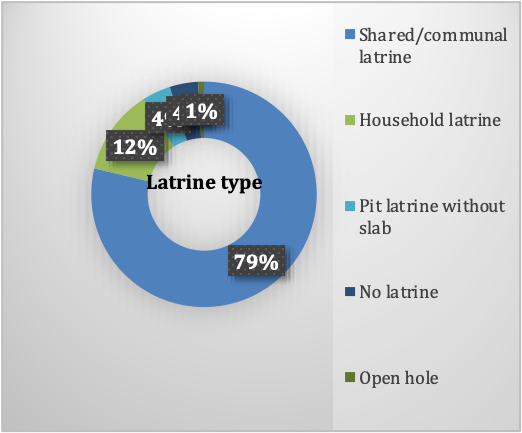
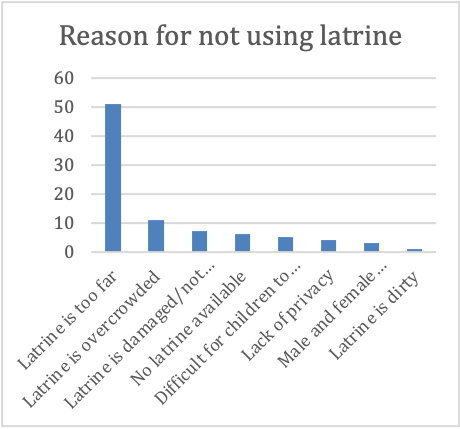
Communal sanitation dominates: 96 households (78.7%) mainly use shared or communal latrines, while only 15 (12.3%) use household latrines. Although 59 households (48.4%) report always using a latrine, 57 (46.7%) use one only sometimes and 6 (4.9%) usually do so. Distance is the main reported reason for inconsistent use (51 households; 41.8%), followed by overcrowding, damaged or non-functional facilities, and lack of an available latrine.
For implementation monitoring, IHADS should assess the number of households served per communal latrine, waiting times during peak periods, cleanliness, privacy and safety, functionality, and whether users can access facilities promptly when required.
These results suggest that sanitation programming should prioritize the usability and location of communal facilities rather than focusing only on construction numbers. When facilities are too far away, overcrowded, damaged or unavailable, households may use another household’s latrine or an open area. The survey recorded open area use among 19 households in the relevant follow-up question, while environmental observations identified evidence of open defecation around 9.8% of households.
Child faeces disposal is another important risk. Among the 96 households with children under five, only 61.5% reported putting child faeces into a latrine or toilet. The remaining households reported burying faeces, placing them with solid waste, throwing them in an open area, or leaving them where the child defecated. This requires practical, non-judgmental household demonstrations rather than general messaging alone.
3.2 Water access, treatment and safe handling
Protected taps or standpipes are the main reported drinking-water source (67.2%), followed by protected wells (15.6%) and vendors or trucked water (13.9%). Despite the use of improved or protected sources by many households, physical access remains difficult: 78.7% identify distance as a barrier, 43.4% report cost, and 32.0% report long queues or waiting times. Irregular availability and difficulty for women to access water are additional concerns.
The main program implication is that source type alone does not demonstrate reliable access. Water interventions should consider proximity, affordability, waiting time and safe access for women and other household members. The survey also shows limited consistency in household treatment: only 20 households (16.4%) always treat drinking water, while 42 (34.4%) treat it sometimes, 18 (14.8%) never treat it and 42 (34.4%) do not know.
The high ‘do not know’ response indicates that households may need demonstrations and follow-up on treatment steps, dosage or method selection, safe storage, and hygienic water handling. Treatment methods were a multi-select question, so the method counts should not be added together as mutually exclusive categories.
3.3 Handwashing and hygiene information
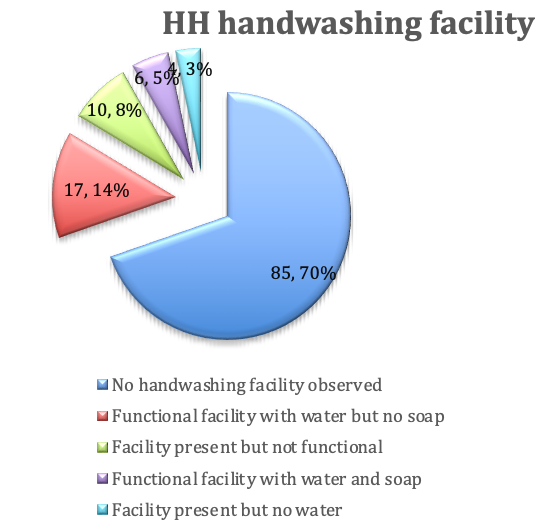
Handwashing infrastructure is the most pronounced observed household-level gap. No facility was observed at 85 households (69.7%), while only 6 (4.9%) had a functional facility with both water and soap. A further 17 households had water but no soap, 10 had a non-functional facility, and 4 had a facility without water.
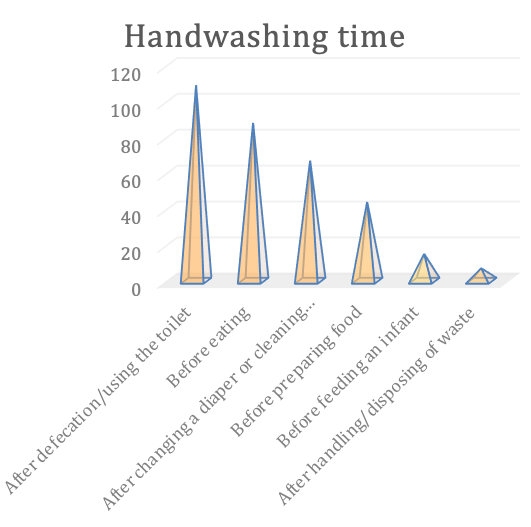
Knowledge is stronger for handwashing after toilet use (89.3%) and before eating (72.1%) than for other critical moments, including after changing or cleaning a child (54.9%), before food preparation (36.1%), before feeding an infant (12.3%) and after handling waste (5.7%). The difference between reported knowledge and observed facilities indicates that information alone is unlikely to produce sustained practice without convenient facilities, water and soap.
Only 18 households (14.8%) received hygiene information during the previous three months. Community leaders were the most commonly identified information channel, suggesting that leaders can support mobilization and trust, while hygiene promoters and community workers should deliver household-level demonstrations, coaching and follow-up.
4. Priority Needs and Strategic Interpretation
Household priorities are consistent with the observed service gaps. The most frequently selected need was access to a clean and functioning communal latrine (103 households; 84.4%). Other priorities included reducing open defecation (58; 47.5%), safe drinking water (43; 35.2%), latrine cleanliness (42; 34.4%), and latrine privacy and safety (32; 26.2%).
| Priority issue | Evidence from baseline | Analytical implication |
| Communal sanitation | 78.7% mainly use communal/shared latrines; 84.4% request clean, functioning communal latrines | Rehabilitate, maintain and monitor facilities, with attention to location, load, cleanliness and accessibility. |
| Consistent latrine use | Only 48.4% always use a latrine; distance is the leading barrier | Improve proximity and functionality while reinforcing safe-use behaviours. |
| Water access | 78.7% report source is too far; 43.4% report cost | Assess access points, affordability, queues and safe access for women. |
| Water treatment | Only 16.4% always treat water; 34.4% do not know | Use practical demonstrations and follow-up on treatment, storage and handling. |
| Handwashing | 69.7% have no observed facility; 4.9% have water and soap | Promote simple facilities and regular soap availability at key locations. |
| Hygiene information | Only 14.8% received information in the last three months | Establish repeated, targeted household visits supported by community leaders. |
| Child faeces | Only 61.5% of households with under-fives use a latrine/toilet for child faeces | Prioritize demonstrations on safe disposal and handwashing after cleaning children. |
5. Recommended Programme Response
- Communal sanitation: rehabilitate or construct facilities based on identified gaps; establish routine checks for cleanliness, functionality, safety, privacy and user load; and include accessibility features where feasible.
- Sanitation behaviour: combine infrastructure improvements with household and community messaging on consistent latrine use, open-defecation reduction and safe child faeces disposal.
- Water access: assess the feasibility of improving access points or reducing barriers related to distance, cost, queues and irregular supply, while considering women’s safe access.
- Water safety: conduct demonstrations on appropriate household treatment methods, safe storage, covered containers, clean serving practices and when treatment is required.
- Handwashing: promote affordable, locally feasible handwashing stations at priority points and reinforce soap use, especially after toilet use, after cleaning children, before food preparation and before eating.
- Hygiene promotion: use hygiene promoters for household visits, demonstrations and follow-up, coordinated with community leaders and other WASH and health actors.
- Inclusion and accountability: consult persons with disabilities and other at-risk household members on facility design, and use community feedback to identify access, safety and maintenance problems.
6. Implementation Priorities and Monitoring Framework
The baseline suggests a phased response. Immediate actions should address high-risk and highly visible gaps, while medium-term actions should improve the reliability and sustainability of communal services.
| Priority period | Main actions | Suggested monitoring measures |
| Immediate: 0–3 months | Hygiene promotion, water-treatment demonstrations, soap and handwashing messaging, communal-latrine functionality checks | Households visited; demonstrations completed; functional facilities; facilities with water and soap; households reached with key messages. |
| Short term: 3–6 months | Rehabilitation and cleaning of priority communal latrines; accessibility improvements; strengthened community feedback | Functional and clean communal latrines; reported distance barriers; user feedback; accessible facilities. |
| Medium term: 6–12 months | Review water-access barriers, strengthen maintenance arrangements, repeat household behaviour monitoring | Reported water access constraints; consistent treatment; safe child faeces disposal; consistent latrine use; sustained hygiene-information coverage. |
Monitoring should combine household reporting, direct observation, hygiene-promotion records and community feedback. Indicators should use consistent denominators and clearly distinguish observed conditions from self-reported behaviour. Multi-select questions should continue to be reported as individual response proportions rather than summed into a single total.
7. Conclusion
The baseline confirms substantial WASH needs among the 122 surveyed households in Yaaqle, Baali-Muno and Darusalaam. The most important constraints are reliance on shared sanitation, limited consistent and timely latrine access and use, distance and cost barriers to water, inconsistent household water treatment, very weak handwashing infrastructure, and limited exposure to hygiene information.
The evidence points to an integrated programme rather than isolated messaging or infrastructure activities. Improvements in communal latrine access and maintenance should be combined with practical household behaviour support, safe water treatment and storage, simple handwashing facilities, and repeated engagement through hygiene promoters and community leaders. The baseline provides a reference for implementation monitoring and future endline comparison, provided that the same definitions, denominators and observation procedures are maintained.